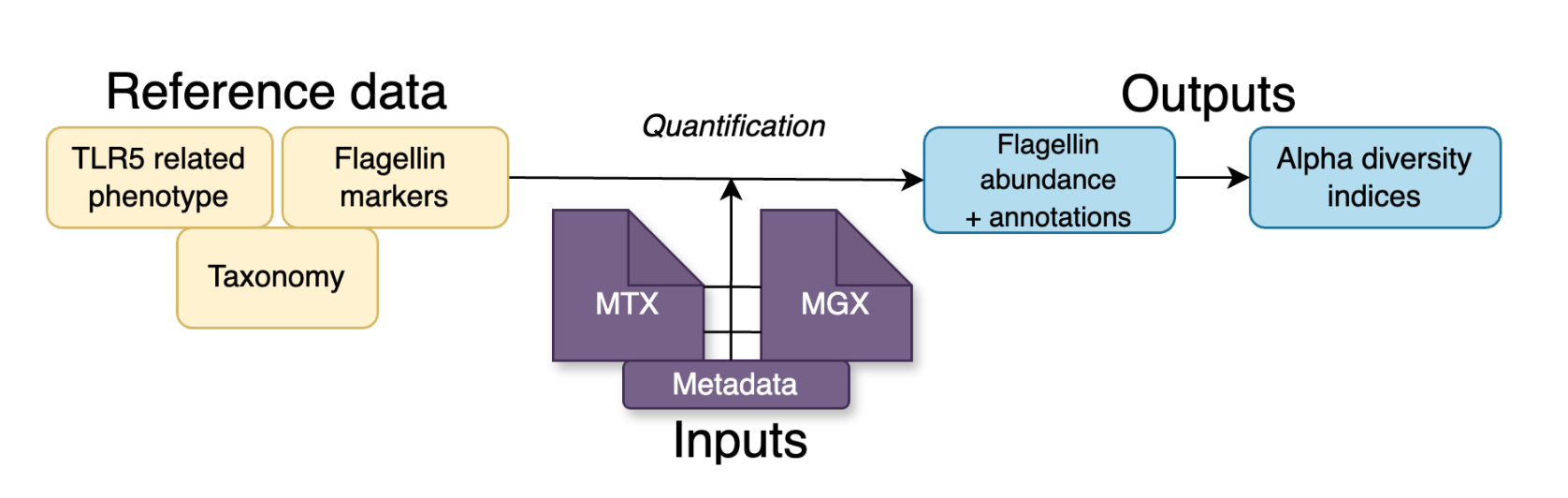
We are pleased to announce the publication of our latest study, “Human gut flagellome profiling using FlaPro reveals TLR5-related phenotype-specific alterations in IBD.”
In this work, we introduce FlaPro, a computational pipeline for quantifying and functionally annotating the human gut flagellome within a microbiome sample. Because flagellins vary widely in their ability to bind and stimulate the innate immune receptor TLR5, we built a machine learning model, trained on experimentally characterized flagellins, that sorts these proteins into stimulatory and silent classes directly from metagenomic and metatranscriptomic data.
Applying FlaPro to a multi-omics inflammatory bowel disease (IBD) cohort, we found a marked depletion of flagellome diversity and a reduced ratio of silent to stimulatory flagellins in both Crohn’s disease and ulcerative colitis. These shifts were consistent across the genomic and transcriptional layers, pointing to a disease-associated move toward more immunostimulatory flagellome profiles.
These findings suggest that specific features of the gut flagellome contribute to TLR5-mediated immune activation and may serve as functionally interpretable markers for future microbiome-wide association studies in health and disease. By turning a compact but immunologically important gene family into a quantifiable, biologically meaningful readout, this work bridges large-scale sequencing surveys with the mechanistic biology of host–microbiome interactions.
The workflow is openly available at https://github.com/leylabmpi/FlaPro.
Read the full paper: https://www.tandfonline.com/doi/full/10.1080/19490976.2026.2698917